

 JOIN and enjoy exclusive benefits!


Traveling alone for the first time in Spain: 11 destinations to embark on an adventure
21/08/2026
Have you ever felt that when you travel, you end up eating at the same type of place as you do at home? Málaga is not a city for repeating routines. Here, eating is a pleasure if you let yourself be carried away by the rhythm of its streets. If you're looking for where to eat in Málaga like a local, forget the laminated guides; we're going to explore everything from crispy fried fish to the most soulful afternoon drinks.
What to Eat in Málaga: Typical Dishes to Order with Flair
The essence of Malagueñan cuisine: from espetos to sweet wine.
Malagueñan gastronomy mixes the Mediterranean, local produce, and a lot of tradition from the bar, beach, and market. And yes, the espeto reigns here, but it doesn't come to the party alone. If you want to eat like a local, these are the dishes and drinks that should not be missing from your palate.
Espetos, Fried Fish, and Beachfront Chiringuitos
Some things are only understood in Málaga. One of them is the sardine espeto: fresh sardines skewered on reeds and slowly grilled over embers, with the sea as the only accompaniment. The result is a juicy fish with a smoky hint that you won't forget.
Here are some must-tries:
Fried fish is the other great emblem of Malagueñan cuisine. Anchovies, red mullet, squid, and cuttlefish coated in flour and fried in olive oil. Crispy on the outside, tender on the inside.
- Fried fish (Pescaíto frito): small battered and fried fish, crispy on the outside and juicy on the inside. Ideal for sharing.
- Fried anchovies (Boquerones fritos): one of the most recognizable bites of local cuisine. If well-made, they disappear from the table at magic trick speed.
- Fresh fish: depending on the season, it can be grilled, fried, or served in simple portions. Here, the produce matters more than posing.
To eat espetos or fried fish, head to the beachfront chiringuitos, they preserve that classic beach bar feel where the smoke from the grill will already be whetting your appetite before you sit down:
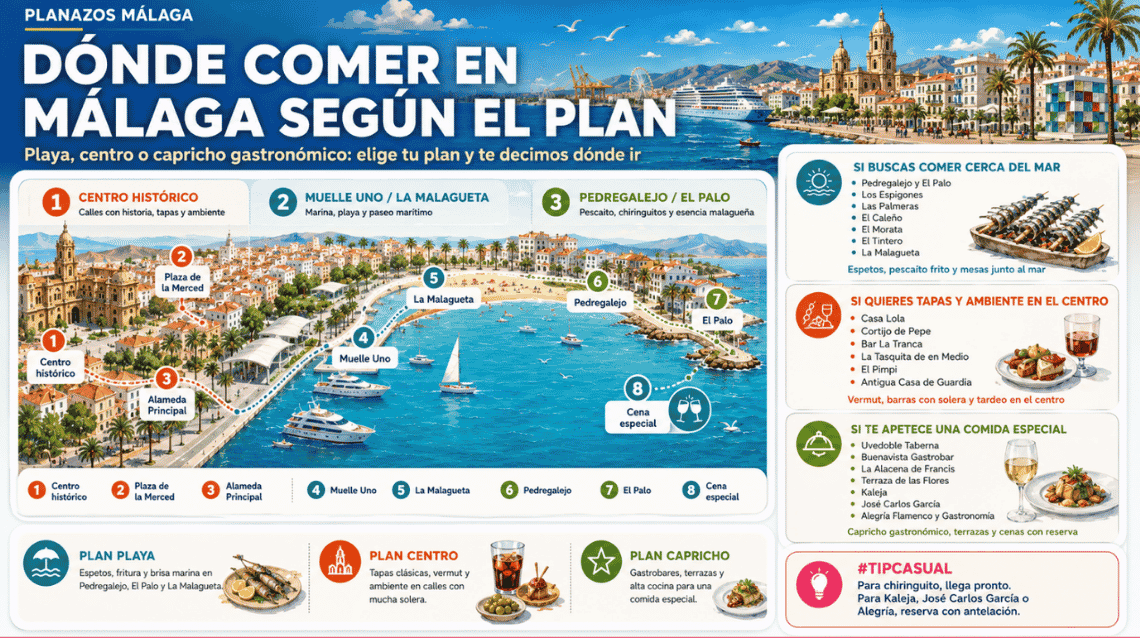
- Pedregalejo and El Palo: the quintessential fishing neighborhoods. Chiringuitos like Los Espigones, Las Palmeras, or El Caleño are safe bets if you're looking for authenticity.
- If you want something with more spectacle and folklore, El Tintero is a must-visit where dishes aren't ordered from a menu; instead, the waiters "sing" them and serve them on the fly.
- La Malagueta: the most famous urban beach, with chiringuitos right on the sand and views of the port.
More than just a beach bar, the chiringuito is the soul of the Costa del Sol. It's an establishment right on the sand where the ritual dictates: fresh fish caught that very morning, grilled over wood fires in sand-filled boats, and served overlooking the Mediterranean.
Casual Tip: Avoid surprises on the bill and always ask the price of "by weight" fish before ordering. In many chiringuitos, large grilled pieces (like sea bass or snapper) are charged by their weight.
Cold Soups, Stews, and Traditional Malagueñan Cuisine
Málaga boasts a repertoire of cold soups that is the envy of half the country:
Porra antequerana is the star: tomato, pepper, bread, olive oil, and garlic, topped with ham, hard-boiled egg, and tuna. Ajoblanco is a cold soup of almonds, bread, garlic, and olive oil, served with Moscatel grapes. Gazpachuelo, less known but equally delicious, is a fish soup with mayonnaise that gives it a unique creamy texture.
In addition to soups, Málaga's pantry shines with:
- Berza malagueña: a hearty stew of legumes and vegetables, perfect for cold days.
- Ensalada malagueña: potato, orange, cod, and olives, a surprising combination.
- Almond sauce meatballs: a dish with Andalusian heritage.
- Malagueñan suckling lamb: roasted or in sauce, one of the most valued dishes in the province.
If you want to try them without leaving the city center:
- The Atarazanas Market is the best starting point. There you'll find stalls with fresh produce (seafood, fried fish, or salads), and bars where you can eat standing up, like the famous El Yerno. The atmosphere is bustling, authentic, and very Malagueñan.
- To try spoon dishes like berza or suckling lamb, look for the traditional restaurants in the old town.
The market is for the freshest seafood; slow-cooked dishes require a tablecloth and time.
The market closes between 2:00 PM and 3:00 PM, so arrive early to avoid queues. And remember: always ask for prices before ordering. Some stalls don't display them, and it's better to be safe than sorry.
Sweets, Malagueñan Coffee, and That Secret Language of the Cup
In Málaga, ordering "a coffee with milk" is a sure way to reveal yourself as a tourist. Coffee is its own language measured in percentages of milk. If you want to blend in like a local, learn this scale:
- Nube (Cloud): 90% milk and 10% coffee. It's practically milk with a spot of coffee.
- Sombra (Shadow): 80% milk and 20% coffee. A very mild coffee, ideal to start with if you're not used to the local strength.
- Mitad (Half): 50% milk and 50% coffee. The standard, equivalent to a traditional café con leche.
- Largo (Long): 90% coffee and 10% milk. Only for those seeking an energy boost without giving up a touch of milk.
- Solo (Alone): black coffee, no milk.
Where to go:
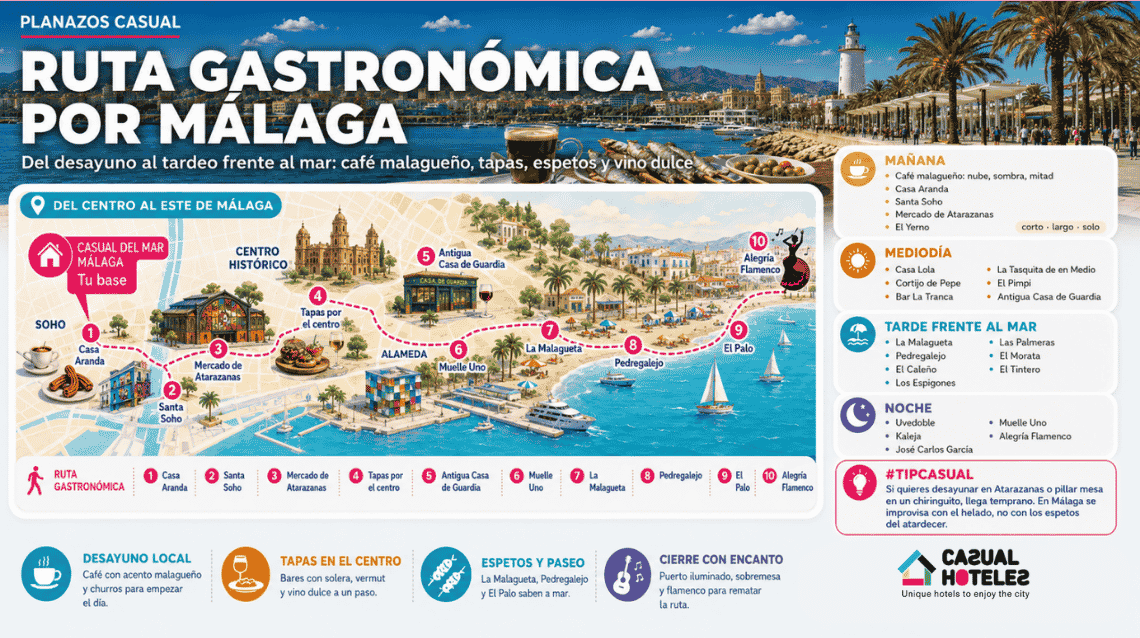
Casa Aranda: the churro institution with chocolate since 1932. Order "porras" (which is what they call churros here) and thick hot chocolate. There's always a queue, but it moves quickly. C. Herrería del Rey, 2.
Santa Soho: if you prefer something more modern, this specialty coffee shop in Soho serves brunch, crepes, and artisanally roasted coffee. C. Tomás Heredia, 5.
To accompany your coffee, Málaga has a pastry heritage worth exploring:
- La Loca Malagueña: a sponge cake with almonds and sweet wine. It's the crown jewel in any artisan pastry shop in the center.
- Pasas de la Axarquía: if you're looking for a natural snack, nothing beats raisins from the Axarquía region, unique for their sun-drying process.
- Churros/Porras: what they call "churros" here are actually porras (thicker and spongier).
For coffee, if you don't know what to order, start with a "sombra" and experiment. For something sweet, ask in any pastry shop in the center for the "loca malagueña." Avoid franchises or places that don't have a constant flow of people, as in Málaga, the quality of coffee or a porra depends almost exclusively on how "freshly made" it is.
Tapas, Markets, and Wines: Málaga to be Tasted at the Bar, Terrace, or Bodega
The city is best enjoyed on the street, in its markets, and in its centuries-old bodegas.
Málaga is inseparable from its tapas culture. Here, you eat standing at the bar, sharing, and without rush. Each neighborhood has its classics, and each bodega holds decades of history among its barrels.
Atarazanas Market and Traditional Bars
The Atarazanas Market is the gastronomic heart of the city. A building with an impressive horseshoe archway dating back to the Nasrid era. Inside, the bustle of fish, fruit, vegetable, and meat stalls coexists with bars where you can eat standing or on stools.
There are no tablecloths or reservations here. You order, you eat, and you enjoy. The atmosphere is local, authentic, and chaotic in the best sense. It's the perfect place to start the day like a true Malagueñan.
Some traditional bars in the center worth a stop:
- Casa Lola: a classic for tapas with Andalusian flavor. Patatas bravas, ensaladilla, and pickled anchovies. C. Granada, 46.
- Cortijo de Pepe: in Plaza de la Merced. Good fried fish and Galician-style octopus. Pl. de la Merced, 2.
- Bar La Tranca: a tavern with soul. Omelets, empanadas, and homemade vermouth. C. Carretería, 92.
- La Tasquita de en Medio: small, bustling, and with amazing croquettes and flamenquín. C. Calderería, 11.
- La Farola de Orellana: traditional and economical, a lifelong classic. Tapas with Andalusian flavor in a small and charming atmosphere.
Casual Tip: If you don't know what to order, look at what the person next to you is ordering. In the Atarazanas Market, oral tradition is more reliable than any menu.
Tapas in Málaga: Taverns, Vermouth, and City Center Classics
The historic center of Málaga is full of nooks where tapas become an art. Calle Granada and Plaza de la Merced concentrate some of the city's most traditional bars.
El Pimpi ( C. Granada, 62) is an institution. More than a bar, it's a cult place. Its walls are covered with photos of celebrities who have visited, and its terrace with views of the Roman Theater is one of the best places to have a wine and some ham.
Other classics that never disappoint:
- El Tapeo de Cervantes: elaborate tapas with quality produce. The tuna tataki with ajoblanco is its star. C. Cárcer, 8.
- El Mesón de Cervantes: a larger version of the previous one. Good portions and family atmosphere. C. Álamos, 11.
- Taberna Uvedoble: contemporary tapas in the heart of the city. The salmorejo with scallops is a delight. C/ Alcazabilla, 1.
- Buenavista Gastrobar: oxtail croquettes and tempura cod. Artistic and cozy atmosphere. C/ Gaona, 8.
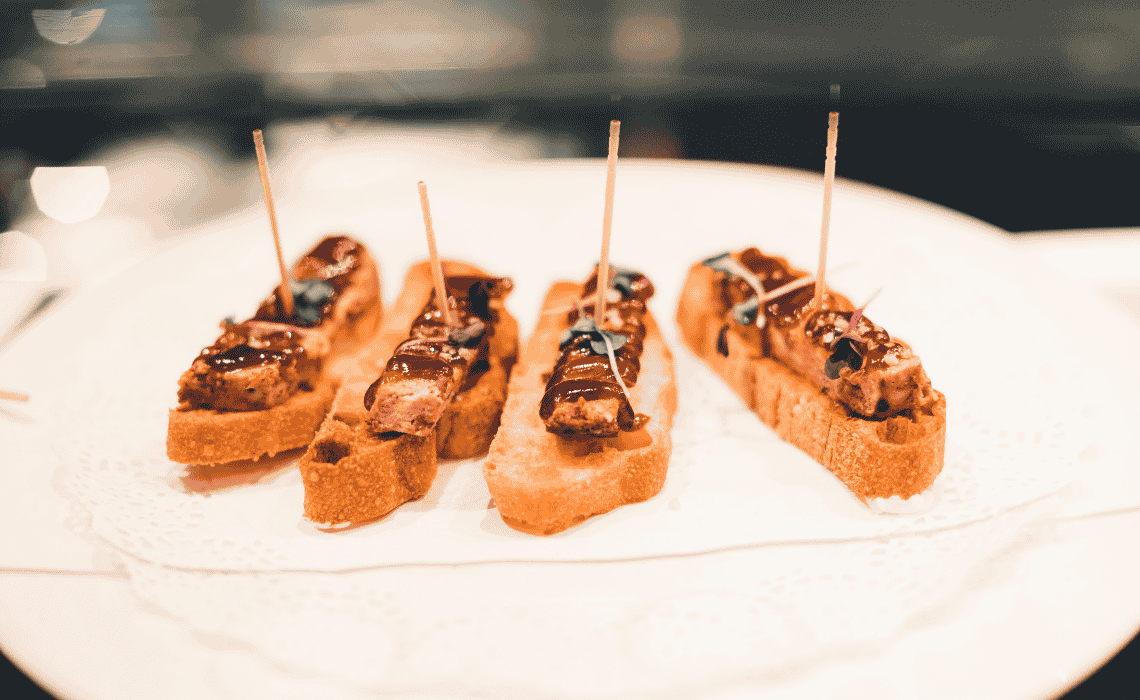
Casual Tip: If you can't be bothered to choose, ask the waiter. In these places, they know how to recommend and never fail.
Málaga's Sweet Wine: Moscatel, Pedro Ximénez, and Bodegas with History
Málaga has a wine that deserves its own chapter. Málaga's sweet wine is unique: with a Protected Designation of Origin, it's made from Moscatel and Pedro Ximénez grapes that are sun-dried. The result is an intense wine, with notes of raisins, candied fruits, and a hint of acidity that makes it addictive.
The temple of this wine is Antigua Casa de Guardia, the oldest tavern in the city (founded in 1840). Here, wines are served directly from the barrel. There is no menu: you order, you taste, and you pay for what you've drunk. Alameda Principal, 18.
Other bodegas and spaces to try sweet wines:
- El Pimpi: they also have a good selection of local sweet wines.
- La Odisea de los Vinos Málaga: a shop-bodega with tastings and pairings.
Casual Tip: Sweet wine is drunk in small glasses, in sips. Pair it with a piece of cheese or raisins from Axarquía. The combination is one you won't forget.
How to Plan Your Gastronomic Getaway in Málaga and Not Fail
To enjoy Málaga like a local, the key is not just choosing the place, but knowing how to navigate its rhythms and unwritten rules. These steps will help you organize your route without improvising and without losing your flair:
- Adjust your schedule to the local rhythm: the main meal is served between 1:00 PM and 3:30 PM; dinner, from 8:30 PM onwards. Chiringuitos open from 12:00 PM-1:00 PM, and the Atarazanas Market closes between 2:00 PM and 3:00 PM. If you go earlier, you'll find the places empty or without the atmosphere you're looking for.
- Differentiate reservation policies: in traditional tapas bars like Casa Lola, Cortijo de Pepe, or Bar La Tranca, you don't reserve: you arrive and look for a spot, especially in the Atarazanas Market. In modern gastro-bars like Uvedoble or Buenavista Gastrobar, booking is recommended. In Michelin-starred restaurants like Kaleja or José Carlos García, reservations are mandatory weeks in advance.
- Manage waits intelligently: places like El Pimpi or Casa Aranda are always crowded. If you want to avoid the longest queues, go at opening time (12:00 PM-1:00 PM) or during the afternoon hours (5:00 PM-7:00 PM). At El Tintero, the "auction" system makes waiting part of the experience.
- Master the coffee language: ordering "a café con leche" is the quickest way to betray yourself as a tourist. Order a "nube," "sombra," or "mitad" depending on the proportion of milk you prefer. It's the ultimate gesture to connect with the local service.
- Combine styles: don't get stuck in a rut. Dedicate a day to the traditional bar and tapas route (Casa Lola, Bar La Tranca, La Tasquita), and another to author's cuisine (Uvedoble, Buenavista Gastrobar, La Alacena de Francis). The contrast between fried fish at a chiringuito and a tasting menu at Kaleja defines the current Malagueñan gastronomic experience.
- Always ask the price of "by weight" fish: at the chiringuitos in Pedregalejo and El Palo, large grilled pieces (sea bass, snapper, sea bream) are charged by weight. Ask naturally: "Approximately how much does this piece weigh?" or "What would be the approximate price?". The waiters are used to it and will gladly clarify.
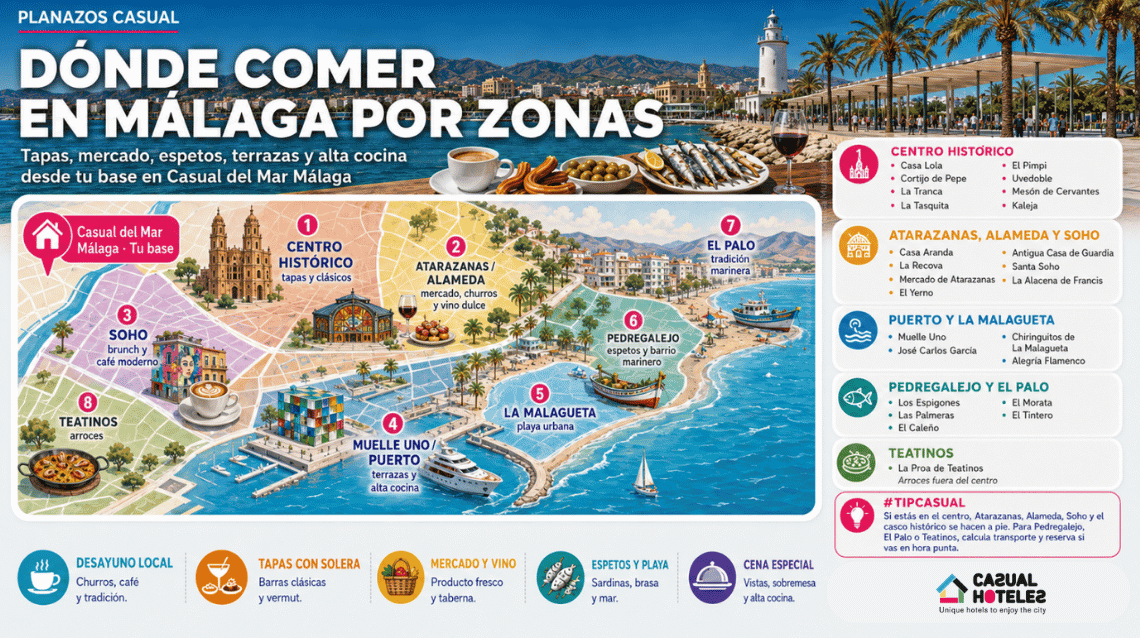
- Stay in the center: the historic center concentrates most of the bars and restaurants. Stay in the center to walk to all the places. For the chiringuitos in Pedregalejo and El Palo, check transportation before you leave; they are not in the center, but the trip is worth it.
Where to Stay in Málaga: Your Stay in the Heart of Malagueñan Flavors
After a tour of espetos, tapas, and sweet wine, exploring the center, the fishing neighborhoods, and the terraces with views, it's time to put the finishing touch on the experience. To make your experience complete, your location should be so close to the local flavors that you can literally walk back after your last glass of wine.
Casual del Mar Málaga is your strategic base, a stone's throw from the best places to eat. It's just a 5-minute walk from Atarazanas Market and Calle Larios, and 3 minutes from the Málaga Centro-Alameda train station.
Note: This guide is updated with information collected in July 2026. The gastronomic offer is dynamic, and the hours or policies of establishments change frequently. Before visiting, always check the current status of your favorites on their social media.
Frequently Asked Questions about Where to Eat in Málaga
Where should I eat in Málaga if it's my first time?
If it's your first visit, start in the historic center with some tapas at Casa Lola or El Pimpi, discover the Atarazanas Market, and finish the day with espetos by the sea in Pedregalejo, El Palo, or La Malagueta. This way, you'll taste some of the city's most representative flavors on a single route.
What is typical of Málaga?
Málaga tastes like freshly made espeto, fried fish, sweet wine, porra antequerana, and coffees with their own names like nube, sombra, or mitad. Come hungry, because every stop here has something delicious to tell.
What is the most typical dish in Málaga?
If you could only try one, make it a good sardine espeto overlooking the Mediterranean. It's the great symbol of Malagueñan gastronomy and an experience that tastes even better with the sea breeze.
What is the main street for restaurants in Málaga?
Calle Granada and Plaza de la Merced form the heart of Malagueñan tapas, with classics like Casa Lola, El Pimpi, or Cortijo de Pepe. Calle Larios is perfect for a stroll, but just a few meters away, you'll find many of the city's best-known taverns and gastro-bars.
Where to eat espetos and fried fish in Málaga?
The chiringuitos in Pedregalejo, El Palo, and La Malagueta are the best option to enjoy freshly grilled fish and traditional fried dishes. There you'll find classics like Los Espigones, Las Palmeras, El Caleño, or El Tintero, famous for serving dishes with its unique auction system.
Where to drink sweet wine and try typical Malagueñan sweets?
Start with a glass of sweet wine at Antigua Casa de Guardia, where it's still served directly from the barrel, and complete the experience with a loca malagueña or some porras with chocolate at Casa Aranda. They are two classics that summarize the city's gastronomic tradition.
How do you order coffee in Málaga?
Coffee here has its own language. You can order a nube, sombra, mitad, largo, or solo, depending on the proportion of milk and coffee you prefer; mastering this vocabulary is almost an initiation rite for having breakfast like a local.
Where to eat cheaply or have a set lunch menu in Málaga?
The Atarazanas Market, La Recova, or La Farola de Orellana are good options if you're looking to eat well without spending too much. Additionally, many restaurants in the center offer set lunch menus with homemade cuisine and local produce at very competitive prices.
Do I need to book at restaurants in Málaga?
It depends on the type of establishment. In traditional bars like Casa Lola or Bar La Tranca, it's usual to arrive and wait for a table, while in gastro-bars like Uvedoble or restaurants like Kaleja or José Carlos García, it's advisable to book in advance, especially on weekends.
Where to stay to explore Málaga's gastronomy without a car?
Staying near the historic center will allow you to walk to the Atarazanas Market, the main taverns, bodegas, and restaurants in the city, as well as easily reach La Malagueta. At Casual del Mar Málaga, you'll have a strategic location to discover the most authentic flavors of Málaga without worrying about a car.