

 JOIN and enjoy exclusive benefits!



What to see in Athens in 2 days: Acropolis, Plaka and the best sunset views
15/10/2026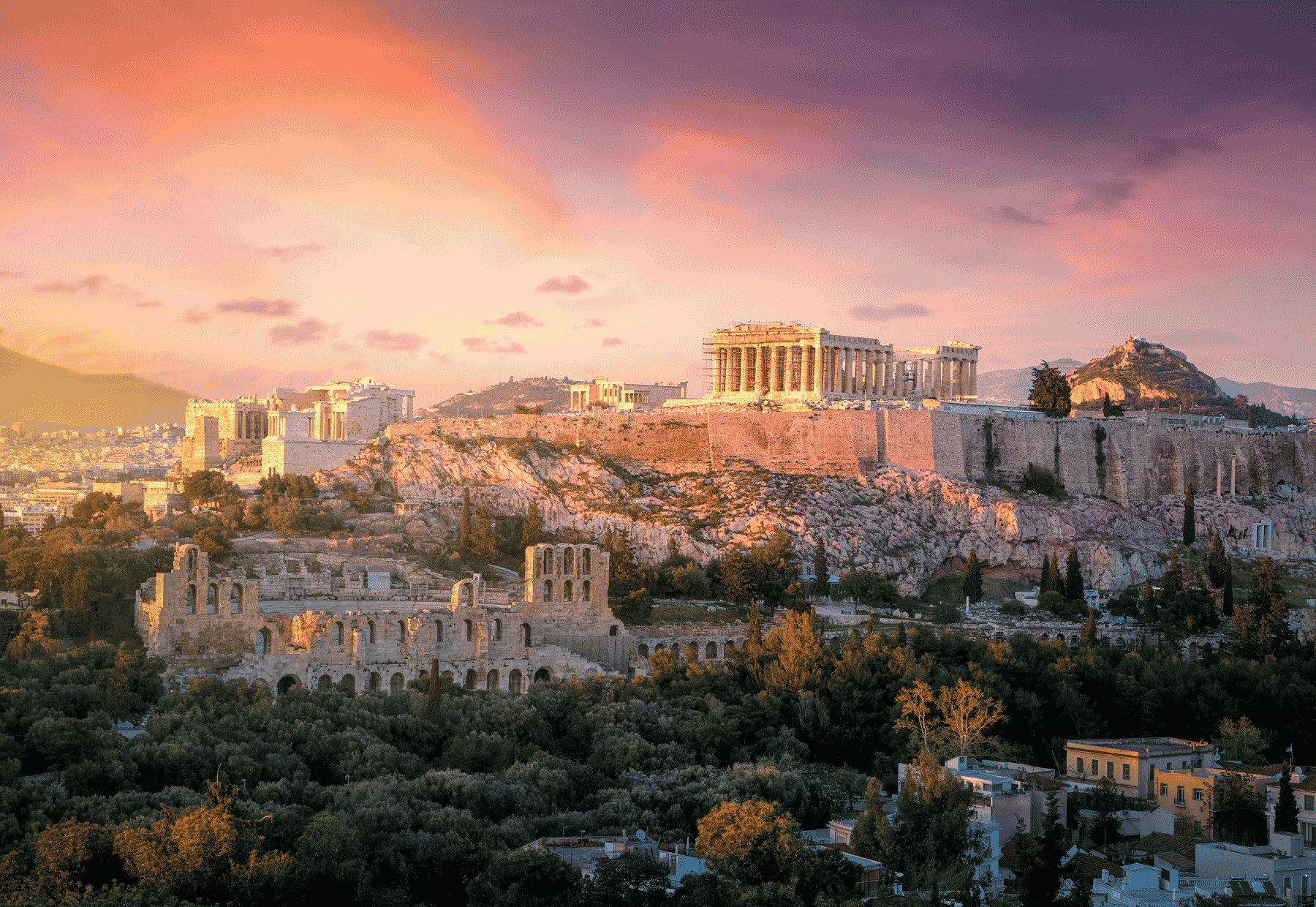
First time in Athens and only have 48 hours? Knowing what to see in Athens without turning the trip into a race has a trick: looking at the city from various angles. Acropolis first thing in the morning, neighborhoods to explore on foot, and a sunset with perspective form a two-day route designed to make the most of your time and enjoy the journey.
What to see in Athens on the first day: Acropolis, Plaka, and the sunset from Filopappou
The first day focuses on the monumental heart of Athens. The Acropolis and its museum take up the morning; Plaka and Anafiotika then give way to an afternoon on foot that culminates at Filopappou, with the Areopagus as a shorter alternative.
Grouping these visits in the same area avoids unnecessary travel and saves the first hours for the open-air monuments.
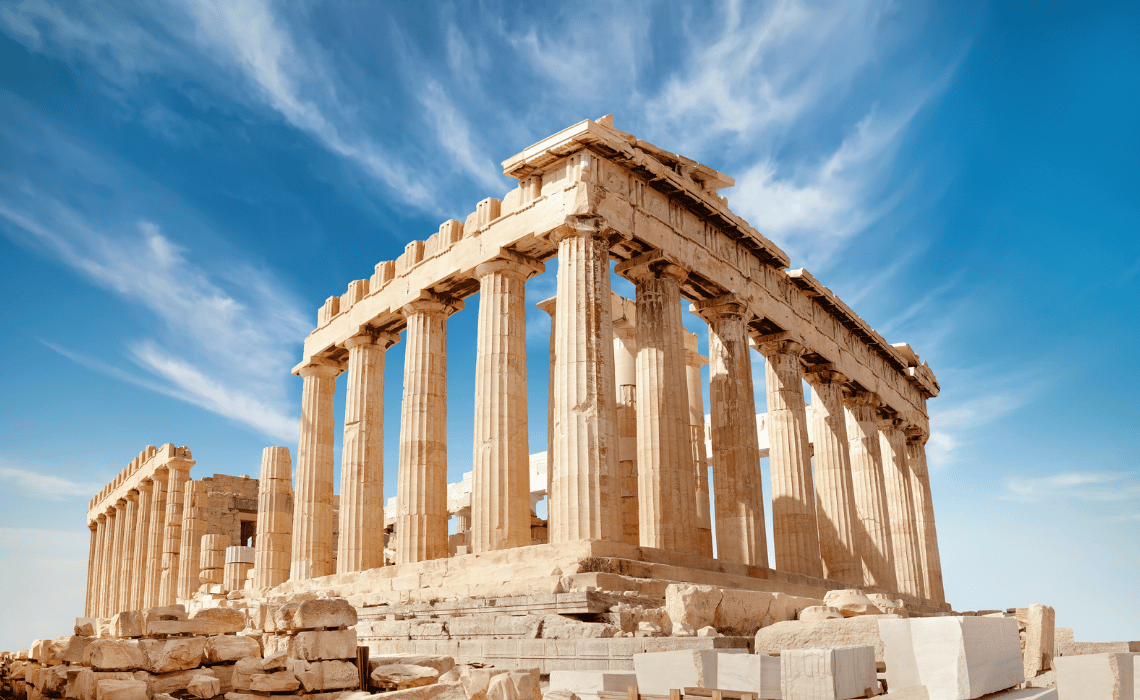
Acropolis and Parthenon first thing in the morning
The Acropolis of Athens opens at 8:00 and that first slot is especially interesting during the warmer months. In 2026, the general admission is €30 and the reduced one is €15. Closing times vary throughout the year: from April to August it is at 20:00; in September and October it is moved forward progressively, and from November to March, it is at 17:00. Last admission is 20 minutes before closing.
If you already know the date of your trip, book your ticket on the official Hellenic Heritage platform. Allow between two and three hours as a reference to tour the Acropolis and its slopes without turning the morning into a collection of rushed photos.
Inside the complex, these are the stops worth recognizing:
- Propylaea: they are the monumental entrance to the upper part. Crossing them serves as an introduction before encountering the great temples.
- Temple of Athena Nike: this small Ionic temple stands next to the monumental entrance and is part of the Acropolis' architectural program.
- Parthenon: dedicated to Athena Parthenos, it is the great visual reference of the complex. Do not limit yourself to a single view: walking its perimeter helps you appreciate its proportions and its relationship with the rest of the hill.
- Erechtheion and Caryatids: the six figures holding up the current portico are copies. Five originals are in the Acropolis Museum and the sixth is kept in the British Museum.
- Theater of Dionysus and Odeon of Herodes Atticus: both are on the southern slope. The former connects the route with the Athenian theatrical tradition; the Odeon is currently viewed from the outside, as it is closed due to a three-year restoration project.
There is one logistical detail that deserves attention: the “Acropolis and slopes” ticket is single-use. Once you leave the site or the southern slope, you cannot re-enter with the same ticket, so check the signs before crossing the exit.
#TipCasual | At eight, we can't perform miracles either
The first slot doesn't promise an empty Acropolis (that would enter mythological territory), but it avoids the peak sun hours in summer. Water, sunscreen, and footwear with good grip are three basics: the Ministry of Culture itself recommends appropriate footwear for walking around the site.
Acropolis Museum: from the Caryatids to the Parthenon Gallery
After the hill, the Acropolis Museum helps to put names and context to what you have just toured. The sequence makes particular sense in front of the Erechtheion: first you see the copies of the Caryatids at the monument, and then you can approach five original sculptures in the museum.
On the third floor, the Parthenon Gallery is oriented according to the original temple and distributes its sculptures according to the position they occupied within it. The glass walls also maintain a direct visual line with the Parthenon, so you can compare the museum and the monument in a single glance.
For a first visit, reserve between an hour and a half and two hours as a reference. Admission is independent of the Acropolis and costs €20 for general and €10 for reduced. The ticket includes the exhibition halls and the archaeological excavation located under the building.
The museum opens at 9:00 every day except for specific closing dates. On Fridays, it extends its hours until 22:00, a useful possibility if you need to reorganize any day.
Plaka and Anafiotika before sunset at Filopappou
After the visits with tickets, the day continues through Plaka, which extends at the foot of the Acropolis among neoclassical buildings, Byzantine churches, small shops, and narrow streets. You don't need to chase another list of monuments here: the walk itself is part of the itinerary.
Inside Plaka, enter Anafiotika, the small set of whitewashed houses built in the 19th century by workers who arrived from the Cycladic island of Anafi. There is one detail that the city itself reminds visitors: it remains a residential area, so walk with discretion and respect entrances and homes.
To close the first day, head to Filopappou Hill. Access is free and its paths lead to one of the most complete perspectives of this sector of Athens, with the Acropolis facing you and views that extend toward the city and the sea. The natural terrain includes irregular stone pavement and not all sections are free of steps.
Check the sunset time before going up and arrive with time to spare. Filopappou is connected to the Acropolis surroundings by the Dionysiou Areopagitou promenade, so the end of the day continues within the same sector covered since the morning.
If your legs have already given their opinion, the Areopagus or Hill of Ares is the alternative. It is about 300 meters west of the Acropolis and offers a very close view of the monumental complex. The climb is short, although the rock is polished by the passage of visitors and requires attention when stepping.
Practical information to organize the first day in Athens
| Place | Schedule | Price | Tip |
|---|---|---|---|
| Acropolis of Athens | Apr 1–Aug 31: 8:00–20:00. Sep 1–15: until 19:30; Sep 16–30: until 19:00; Oct 1–15: until 18:30; Oct 16–31: until 18:00. Nov 1–Mar 31: 8:00–17:00. Last admission: 20 min before. | €30 general / €15 reduced | Book before the trip and prioritize the first slot in warm months. Bring water, sunscreen, and grip footwear. |
| Parthenon, Erechtheion, Propylaea, and Temple of Athena Nike | Same schedule as the Acropolis | Included | Visit all four within the same trip. In the Erechtheion you will see copies of the Caryatids; five originals are in the museum. |
| Theater of Dionysus | Within the Acropolis and slopes tour | Included | If you tour the southern slope, reserve a few minutes for the theater before leaving the site. |
| Odeon of Herodes Atticus | Currently closed for restoration | — | View it from the outside route and do not plan an interior visit while the closure continues. |
| Acropolis Museum | Apr 1–Oct 31: Mon 9:00–17:00; Tue–Sun 9:00–20:00; Fri until 22:00. Nov 1–Mar 31: Mon–Thu 9:00–17:00; Fri 9:00–22:00; Sat–Sun 9:00–20:00. | €20 general / €10 reduced | Combine it with the Acropolis on the same day. Look for the Caryatids and the Parthenon Gallery; admission includes the archaeological excavation. |
| Plaka | Free access | No ticket | Reserve this stretch to walk without a closed schedule between the Acropolis and Anafiotika. |
| Anafiotika | Free access | No ticket | Remember it is residential: respect homes, access points, and the peace of the neighbors. |
| Filopappou Hill | Free access | Free | Arrive before sunset. The terrain combines paths and irregular stone, so save energy for the climb. |
| Areopagus / Hill of Ares | Free access | No ticket | Alternative to Filopappou if you are looking for a shorter climb. The polished rock can be slippery; wear footwear with good soles. |
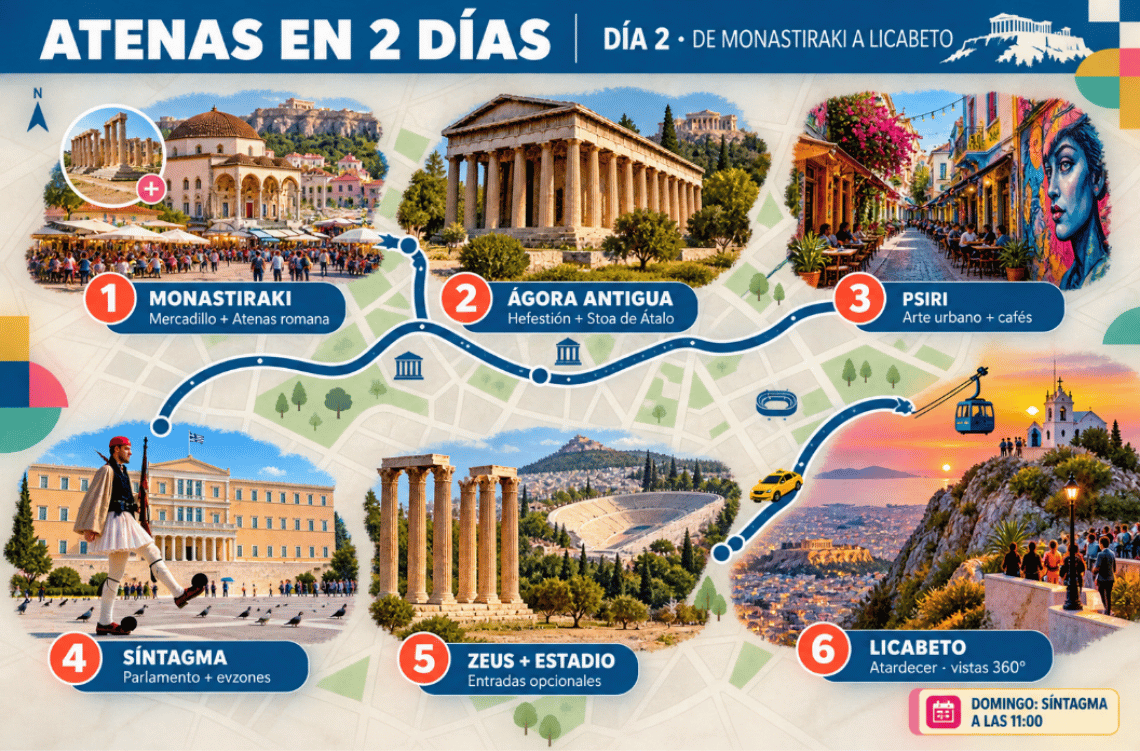
Itinerary of the second day in Athens: Monastiraki, Agora, and Lycabettus
Athens wakes up with another face. After looking at the city from the Acropolis, the second day goes down to the street among street markets, workshops, squares, and ruins that continue to form part of the daily landscape. The route begins in Monastiraki and ends high up, with the complete map unfolded from Lycabettus.
Most of the itinerary is done on foot, but here is a rule your legs will appreciate: you don't have to enter every archaeological site you find.
The Ancient Agora concentrates the main morning visit and the rest adapts to your time, budget, and interests:
- Monastiraki and Roman Athens: start at Monastiraki Square, one of those points where Athens seems to overlap several eras within a few meters. Then enter through Ifestou Street, the axis of the Flea Market, among second-hand shops, antique objects, vinyl records, and souvenirs. On Sundays, the street market atmosphere extends toward Avissinia and Thissio.
A few steps away also appear the Library of Hadrian and the Roman Agora. Both cost €10 separately and can be added if you want to delve into the Roman stage of the city.
For a 48-hour getaway, we suggest them as extras: part of the grounds can be observed from the outside and there is still plenty of Athens ahead. - Ancient Agora, Hephaisteion, and Stoa of Attalos: save time here. General admission costs €20 and gives access to the great public space of ancient Athens, the Temple of Hephaestus, and the Stoa of Attalos museum.
The Hephaisteion is one of the best-preserved ancient temples in the city and occupies a small rise within the site. Afterward, enter the Stoa of Attalos: its reconstruction houses the Agora museum and helps to provide context to what you have just toured. Allow between an hour and a half and two hours as a reference and, in summer, bring water and sunscreen. - Psiri and the Athens that is written on the walls: after the columns comes a change of angle. Psiri mixes workshops, small shops, design, and urban art in a network of narrow streets where the contemporary city takes over.
It does not need a ticket or a timed visit. Walk through some streets, look at the murals, and then continue toward Syntagma. This section introduces air between two monumental blocks and prevents the day from looking like an archaeological exam in sneakers. - Syntagma Square, Evzones, and Tomb of the Unknown Soldier: in front of the Hellenic Parliament, the Evzones perform the changing of the guard every hour, on the hour, before the Tomb of the Unknown Soldier. The visit is free and can be resolved in a short time if you continue following the route.
Sunday changes the rules: at 11:00 the main ceremony takes place, with a larger formation and a military band. If you want to see it, Syntagma goes directly to the first place of the day.
#TipCasual | Sunday is ruled by the clock
If your second day falls on a Sunday, at Casual we would go to Syntagma first for the 11:00 ceremony and then reorganize Monastiraki and the Agora. Athens has two millennia of history; there is no need to try to solve them all before lunch.
- Temple of Zeus, Arch of Hadrian, and Panathenaic Stadium: from Syntagma, continue toward the surroundings of the National Garden and the Temple of Olympian Zeus. Of the 104 columns that the temple had in Hadrian's time, 15 remain standing and another lies in the enclosure. General admission costs €20, although a good part of the structure can be contemplated from the outside.
Very close, the Arch of Hadrian is observed for free before continuing toward the Panathenaic Stadium. Here it is time to choose again: from the outside, you can already appreciate its large marble stands; for €12, admission includes track, stands, passage, museum, and an approximately 30-minute audio guide. If the clock starts ticking, prioritize according to what interests you most instead of collecting ticket stubs. - Mount Lycabettus at sunset: after several hours of walking, this is the time to play with logistics. Take a taxi to the upper area of Kolonaki and continue to the lower station of the Lycabettus funicular, on Aristippou/Ploutarchou.
The funicular costs €13 round trip or €10 for one way, takes about three minutes, and travels entirely through a tunnel. Yes, here the suspense lasts until the doors open: the visual reward begins at the top.
From its 277 meters, Lycabettus opens up the Athens plane. The Acropolis stops occupying the entire scene and becomes part of a landscape of neighborhoods, avenues, and hills that extends toward the horizon. If you go at sunset, arrive with time: the upper area concentrates more visitors as the sun goes down.
| Place | Price | Priority in 48 h |
|---|---|---|
| Ancient Agora | €20 | Priority: includes Hephaisteion, Stoa, and museum |
| Roman Agora | €10 | Optional according to archaeological interest |
| Library of Hadrian | €10 | Optional; part of the site is visible from outside |
| Temple of Zeus | €20 | Optional; you can contemplate part of the complex from the outside |
| Panathenaic Stadium | €12 | Optional; enter if you are interested in Olympic history and want to tour the track, stands, and museum |
| Lycabettus Funicular | €13 round trip | Optional; reduces the climbing effort |
| Lycabettus | Free | Priority for the end of the day |
How to organize Athens in 2 days: times, walks, and best time
Two days in Athens are enough, but your legs also have a right to vote. The key is to concentrate each day by areas, set aside time for the visits that really need it, and assume that entering every archaeological site does not make the trip more complete, only tighter.
Before leaving, these decisions help calculate a realistic pace:
- Count on more kilometers than marked on the map: as a reference, official accessibility itineraries total about 2.3 km between Syntagma, Monastiraki, and Thissio, and nearly 3 km between Syntagma, National Garden, Temple of Zeus, and Panathenaic Stadium. To that, you have to add what you walk inside the Acropolis, the Agora, Plaka, Psiri, and the hills.
- Reserve more time for priority visits: Acropolis, Acropolis Museum, and Ancient Agora need the largest blocks of time. Library of Hadrian, Roman Agora, Temple of Zeus, and Panathenaic Stadium can be added depending on interest, budget, and time.
- Use transport when your feet start to negotiate: the historic center is great for walking, but the trip to Lycabettus is a good time to resort to the metro, taxi, or urban transport. In 2026, the 90-minute ticket costs €1.20 and the 24-hour one costs €4.10.
- Keep a buffer between one visit and another: archaeological schedules vary by season, climbs take time, and Plaka has a curious ability to make you turn down a street that wasn't in the plan.
Visit our website and find out about the activities we design so that you can connect with the historical legacy and social life of one of the most incredible cities in Europe. Create unforgettable memories in the cradle of Western civilization with our guided tours: private tour of Athens, walking tour of the Acropolis and the Parthenon with an expert guide, and Cape Sounion and Temple of Poseidon at sunset among others; and day trips: full day to the Saronic Islands from Athens, full day to Mycenae, Epidaurus, and Nafplio, two days in a small group to Meteora from Athens, or one day to Delphi from Athens; we also have tickets to the main attractions that Athens has.
How many days do you need to get to know Athens
Two days are enough for a first visit focused on the great landmarks of the historic center. Acropolis, Parthenon, Acropolis Museum, Plaka, Monastiraki, Ancient Agora, Psiri, and Syntagma can be divided into two days without crossing the city from end to end multiple times.
With a third day, you can add the National Archaeological Museum, Kerameikos, or other neighborhoods and sites with more time. Because Athens has been waiting for a few centuries; there is no need to solve it all in one weekend.
The best time to tour Athens on foot
- Spring and autumn have friendlier temperatures for spending several hours walking. Between March and May, the official Athens guide places the average near 19 °C. Autumn maintains mild days and leaves behind some of the heat and influx of the central summer months.
- July and August require another strategy: temperatures can reach 40 °C. Reserve the first hours for the Acropolis and other exposed sites, bring water, sunscreen, and a cap, and alternate outdoors with covered spaces when the heat strikes.
- In winter, there are fewer hours of light and several sites close early. The Acropolis, for example, goes from closing at 20:00 between April and August to doing so at 17:00 from November to March. Check official schedules shortly before the trip, especially if you have a visit planned for the afternoon.
Filopappou, Areopagus, or Lycabettus: which viewpoint to choose
Filopappou, Areopagus, and Lycabettus offer three different ways to look at Athens. The difference is in the proximity of the Acropolis, the effort of the climb, and the place where you are at the end of the day:
| Factor | Filopappou | Areopagus | Lycabettus |
|---|---|---|---|
| View type | Acropolis protagonist, city, and sea | Very close and frontal Acropolis | Wide panoramic view over Athens |
| Location | Next to the Acropolis–Plaka axis | About 300 m west of the Acropolis | In the Kolonaki area |
| Climb | Paths and irregular stone | Shorter, on polished rock | Paths or stairs; funicular option |
| Access | Free | Free | Free; funicular for a fee |
| Choose it if… | You want to dedicate the sunset to a wide view of the Acropolis | You are looking to reduce the climb at the end of the day | You want to contemplate Athens as a great urban map |
- Filopappou keeps the Acropolis in the foreground and opens the view toward the city and the sea.
- The Areopagus brings the monumental complex even closer and requires less travel, although the polished rock forces you to watch where you step.
- Lycabettus plays with another scale. From its 277 meters, the Acropolis becomes part of a landscape of neighborhoods, avenues, and hills. If you go up at sunset, arrive with time: the upper area concentrates more visitors as the sun goes down. The funicular reduces the final effort, although you will first have to reach its lower station in Kolonaki.
#TIPCASUAL | THREE VIEWS, TWO SUNSETS
In 48 hours, there's no need to turn the hills into a collection. We would choose Filopappou or Areopagus on the first day depending on energy and save Lycabettus for the second. If your legs file a formal complaint, this time they have evidence.
Do you have a third day left? The National Archaeological Museum, Kerameikos, and other corners we left out can then enter the map without squeezing the first two days.
Tour Athens from another perspective with Casual Kubic Athens
After two days among temples, neighborhoods, and viewpoints, Athens begins to take shape with another clarity: the Acropolis dominates the foreground, the streets show their daily pulse, and the hills open new perspectives over the city. Organizing visits by area leaves time to walk, detour when a street asks for it, and reach sunset without turning each day into a race.
If you are still organizing what to see in Athens, at Casual Kubic Athens we look forward to continuing to explore the city from our base in Omonia. We can help you with tickets and experiences in Athens, and we provide luggage storage to also take advantage of your arrival or departure hours. We provide the base; you decide from which angle to start.
Final checklist for your 2-day trip
- Book the Acropolis before the trip and save the ticket on your phone.
- In summer, prioritize the first hours for open-air sites. The first slot reduces exposure to heat, although it does not guarantee finding them empty.
- Bring water, sunscreen, and footwear with good grip. Between sites, polished stone, and hills, your sneakers are going to actively participate in the trip.
- Check official schedules a few days before traveling. Sites move their closing times forward in September, October, and winter.
- Do not buy all the tickets by inertia. On Day 2, prioritize the Ancient Agora and decide on the Library of Hadrian, Roman Agora, Temple of Zeus, and Panathenaic Stadium according to time and interests.
- Leave a margin for Plaka, Anafiotika, and Psiri. These are stretches for walking, not visits that need a stopwatch.
- Choose Filopappou or Areopagus for the first sunset according to the energy you have left and reserve Lycabettus to close the second day.
- If you go up to Lycabettus at sunset, arrive with time and check the schedule of the last funicular before traveling to Kolonaki.
- If Day 2 falls on a Sunday and you want to see the main ceremony of the Evzones, reorganize the morning to be in Syntagma before 11:00.
- Keep some gaps unplanned. Athens has enough ruins to fill the agenda alone; it doesn't need help.
Frequently asked questions about Athens
When to go to Athens?
Spring (April–June) and autumn (September–October) are the best times: the climate is mild (around 25 °C), the crowds are more reasonable, and prices are more adjusted. July and August are hell: temperatures exceed 38 °C and the crowds can ruin the experience.
How many days are needed to see Athens?
With 2 full days, you see the essentials without stress. If you have 3 days, you can add the National Archaeological Museum or a trip to Delphi.
Can you go up to the Acropolis without a prior booking?
Yes, but it is not recommended. In high season, queues can exceed an hour. Buy your ticket online in advance to save time and stress.
Which area is best to stay in Athens?
The historic center is the most practical option: Plaka, Monastiraki, or the Omonia area leave you within walking distance of the main monuments.
Schedules, agendas, and activities can undergo changes, especially in markets and monuments with booking. Check the official pages before organizing each stop.